
I'll never forget watching a friend visiting from abroad tap his foreign credit card hopefully at a bus reader on his first day here — nothing but red lights and an impatient look from the driver. Then I handed him a T-money card I'd grabbed at the convenience store for the price of a coffee, and the whole city suddenly opened up for him. If you do one thing before exploring Korea, make it this.
Start Here: Get a T-money Card
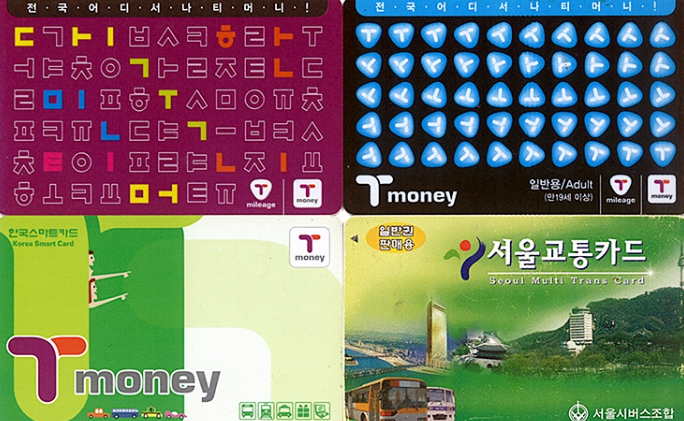
Before anything else, get a T-money card. It's a rechargeable transit card that works on subways, city buses, intercity buses, and even some taxis and convenience stores all over the country.
You can buy one at any convenience store (GS25, CU, 7-Eleven, Emart24) for about ₩2,500–₩4,000. Load it with cash at the machine near the subway entrance or at the convenience store counter.
Why not just use your credit card? Foreign credit cards don't work on Korean buses. Some subway gates now accept them, but T-money works everywhere and gives you a transfer discount that credit cards don't. Get T-money first.
The Subway: Your Main Tool
Seoul's subway has 9 main lines plus several additional routes, covering virtually every neighborhood you'd want to visit. Fares start at ₩1,400 for up to 10km and increase slightly for longer distances.
The key thing to understand is the transfer discount. If you tap out of the subway and tap onto a bus within 30 minutes, you pay significantly less for the continuation. This only works with T-money.
For navigation, use KakaoMap or Naver Map. Both are far more accurate than Google Maps for Korean transit. KakaoMap shows real-time bus locations, walking times between transfers, and even the number of stops remaining.
Buses: Color-Coded and Logical
The bus system in Seoul uses a color-coded route system:
- Blue buses (간선버스) — Main arterial routes connecting major parts of the city. Run frequently, cover long distances.
- Green buses (지선버스) — Local feeder routes connecting neighborhoods to subway stations. Use for the last mile.
- Red buses (광역버스) — Express routes to satellite cities and suburbs outside Seoul. Faster, slightly more expensive.
- Yellow buses (순환버스) — Circular routes within a specific area.
To board, wave your hand when you see your bus coming — drivers don't always stop if no one signals. Tap your T-money card on the reader at the front when boarding, and again when exiting from the back. Forgetting to tap out costs you the transfer discount.
KakaoMap Navigation Tips
Open KakaoMap, tap the search bar, and type your destination in English — it handles English input well for major locations. Select "Transit" from the route options to see multiple options ranked by time, transfers, and walking distance.
The feature I use constantly: tap the bus icon on any route and you'll see the live location of your bus on the map. If it's eight stops away, you've got time to grab a coffee. If it's two stops away, you run. This one feature changed how I move around the city.
Taxis: When Transit Doesn't Make Sense
Korean taxis are affordable and widely available. Base fare starts around ₩4,800. Kakao T (the taxi app) is the most reliable way to hail one — it shows your route to the driver in advance, eliminating the language barrier.
Late-night surcharges apply after midnight (roughly 20% extra). If you're going somewhere complex, show the driver the destination on KakaoMap rather than trying to say it.
Intercity Travel
- KTX (Korea Train Express) — High-speed rail. Seoul to Busan takes about 2.5 hours. Book through the Korail website or Korail Talk app.
- Express buses — Cheaper than KTX, comfortable. Depart from Express Bus Terminal (고속버스터미널) in Gangnam. Book via Kobus.co.kr.
Korean transit spoiled me for every other city I've visited since. Get your T-money card, download KakaoMap, and give it about a week. By then you'll be threading subway-to-bus transfers without even thinking about it.

